By: Hlina Kiros, Research Assistant | Health Effects Institute
Across the globe, a decisive shift is underway. Countries are no longer treating air pollution solely as an environmental issue but rather recognizing it as an important public health and economic concern. While some countries are building systems from scratch, others are strengthening existing frameworks. Data availability and application are improving, institutions are evolving, and conversations are shifting from whether to act to how quickly and effectively progress can be made.
In April, HEI staff gathered with global experts at the 2026 Health Effects Institute Annual Conference in Chicago, Illinois, to reflect on the progress, challenges, and key points of action to improve air quality and ultimately, health and well-being. The session “Global Progress Towards Air Quality Action and Its Impacts,” brought a unique panel of professionals from government, the non-profit sector, and academia from all over the globe to discuss key advancements in air quality actions and future considerations for progress.
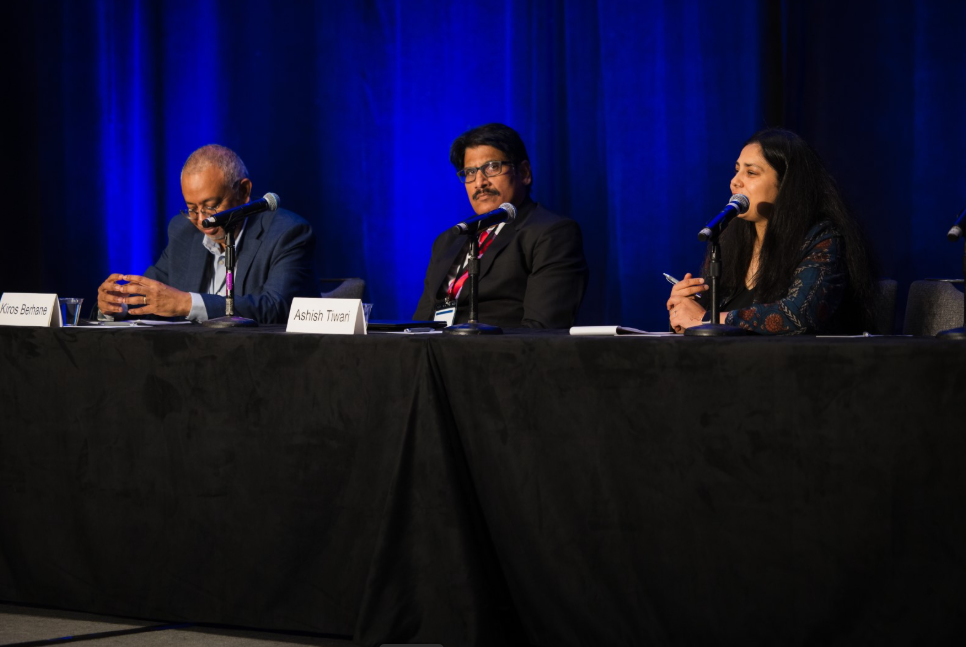
Dr. Kiros Berhane, Ashish Tiwari, and Dr. Pallavi Pant during the panel discussion of the session.
Organizations and Agencies Play Pivotal Roles in Driving Progress
Organizations such as the World Health Organization (WHO), Climate and Clean Air Coalition (CCAC), and the UN Environment Programme are playing a foundational role in establishing science-based air quality guidelines for public adherence and well-being. There is both a strong need and an opportunity for enforced legislation to ensure that guidelines set forth by government and civil societies have significant impacts. For example, Europe has recently established legislation requiring its member states to meet regional air quality standards, an essential achievement in enforcement of existing standards. Local leadership, such as mayors and city commissions, has proven to play a crucial role in advancing urban policies that promote green spaces, healthy and active living, and overall emissions reductions. The use of social and news media, as well as the involvement of professionals from medicine, academia, and industry, disseminates vital information and brings communities together to facilitate conversations toward progress.
Signs of Progress on Household Air Pollution Worldwide
Household air pollution (HAP) is one of the leading contributors to air pollution’s global burden, especially in low- and middle-income countries (LMICs). As of 2016, roughly 3.8 billion people still use solid fuels, or other household activities (e.g., heating and lighting). 2.1 billion people still rely on solid fuels such as wood and charcoal for cooking in their homes, contributing to more than 2.5 million HAP-related deaths worldwide. Many households continue to practice stacking, where clean and harmful fuels are used simultaneously for cooking, reducing the intended benefits of clean practices. Cultural preferences of using traditional methods of cooking and geopolitical events hinder communities’ progress toward adopting cleaner practices. What happens inside the home doesn’t stay inside. While burning of fuels indoors is a major source of HAP, the emissions from such burning also contributes significantly to global outdoor PM2.5 levels.
The good news is that despite this, HAP’s burden has been on the decline since 2000. Deaths from HAP have declined substantially, and nearly 900 million people have gained access to clean cooking since 2010. In Kenya, electricity access has increased by more than 50% since 2010, and initiatives like the 2024 Kenya National eCooking Strategy seek to accelerate the shift to energy-efficient cooking. Similarly, in Nepal, electricity access is now at 90%, and the country is on the path to establishing 2.1 million e-cooking households by 2035. Although the shift is not linear, the resources are available, and a continued shift is possible. Read more about regional progress in the State of Global Air 2025 report.
Clean Air Actions are Accelerating Across Regions with High Pollution Exposure
South Asia
In South Asia, countries are adopting new and impactful frameworks for addressing air quality. These action plans rely on building strategies that are not just local, but regional and across countries as well. India’s National Clean Air Action Programme has been a key framework of progress, where many cities are already showing important steps toward cleaner air. In Nepal, electric vehicle (EV) share of new car sales has increased, making the country a global leader in EV adoption, helping to reduce emissions.
Joint efforts made by politicians, policymakers, community leaders, and scientists across the region have contributed to this progress. Since 2022, the Science-Policy-Finance Dialogue has brought together air quality experts to establish action plans for the region. National programs in Bangladesh, such as the Bangladesh Clean Air Project allocate millions toward implementing large-scale improvements to reduce PM2.5 emissions by 2000+ tons each year. In Bhutan, programs like the National Clean Air Action Plan (NCAAP) establish long-term strategies that focus on source apportionment and emissions, interventions by sector, and improved monitoring. The Brick Kiln Transformation in Pakistan has been a monumental initiative, reducing ~1.7 million tons of CO2 and ~10.7 thousand tons of PM annually.
Latin America
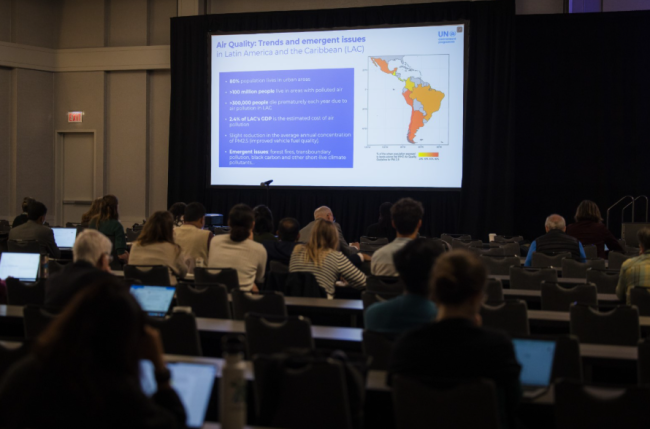
The Latin America region, which sees the highest urbanization rate in the world and thus high exposures to air pollution (above the WHO guidelines), has seen some progress like reducing emissions from transport. Yet several gaps and emerging issues remain to be addressed. A third of countries in Latin America do not have mandatory guidelines for PM2.5, let alone the basic tools for effective implementation. Since 2008, the Air Pollution LAC Network has prioritized the exchange of resources, capacity strengthening, and the development of regional action plans. The Regional Action Plan on Air Quality 2026-2029 details 34 actions across 5 priority areas in progressing toward cleaner air.
Africa
In Africa, progress has been seen in establishing air quality monitoring networks, cross-regional network development, and air quality interventions that have supported decision making in the region. The Integrated African Assessment of Air Pollution and Climate Change for Sustainable Development in Africa aims to improve data availability and establish harmonized scenarios to fill gaps in estimating emissions and quantify impacts of improved air quality and decreases in SLCPs through targeted goals. Following the Assessment, the Africa Clean Air Programme has been developed to support the translation of such goals into coordinated implementation. The growth in regional partnerships across researchers, politicians, and broader stakeholders will be the biggest driver in research and visibility advancements for the entire region.
Data Is Central, but Gaps Persist Across Regions
Health Impact Assessments have become a critical tool in assessing air pollution’s impacts and creating awareness. Yet, a recurring challenge across LMICs is relevant health and air quality data. Data collection, quality, availability, and integration with electronic health records (EHR) remain a barrier for advancements in data analysis. The use of satellite-derived data and remote sensing technology, combined with the use of fixed monitors, are filling gaps. However, satellite data varies with ground-based monitoring data, demanding more sophisticated modeling techniques to enhance spatio-temporal data. The availability and accessibility of EHRs remains an additional challenge in correlating exposure to health. It becomes important to reference data repositories and regional initiatives, such as the Eastern Africa GeoHealth Hub, the Africa Clean Air Programme, the Africa Clean Air Network, African Cities for Clean Air, and the Literature Database for Air Pollution and Health Work in East Africa (LiNDA HEWA), to establish preliminary steps in capacity strengthening, evidence generation, and overall development.
Conclusions
While there has been significant global progress towards addressing air pollution in recent years, the pace has been uneven across regions. Investing in cleaner energy, establishing air quality standards, and advancing data collection and monitoring systems are all essential for continued global progress. Interdisciplinary engagement from scientists, policymakers, and the public is critical to assess priority areas for concern and intervention. Bridging the gap between communities and encouraging South-South cooperation and collaboration is needed to ensure that progress in air quality actions results in improved health outcomes across all communities and for all people.
This blog summarizes insights from the 2026 HEI Annual Conference session “Global Progress Towards Air Quality Action and Its Impacts.” The session was chaired by Dr. Kiros Berhane, Columbia University, USA. Speakers include Dr. Maria Neira, Clean Air Fund; Forrest Robinette, Independent Consultant; Jordi Pon, UNEP, Panama; Ashish Tiwari, ICIMOD, Nepal; Prof. Rebecca Garland, University of Pretoria, South Africa.
Click here to watch the session.
Click here to access the slides presented during the session.