Countries in the Asia-Pacific region experience significant health, economic, and societal costs due to poor air quality. This includes:
- Millions exposed to high levels of air pollution year-round.
- An estimated 5.4 million deaths in 2023 alone.
- Between 4-11% of GDP lost due to air pollution.
There is also a growing disparity: while countries in East Asia have seen significant improvements in air quality, South and Southeast Asia continue to experience high pollution levels. Furthermore, climate change is reshaping air pollution risks and associated health impacts in Asia, with rising ground level ozone and more frequent heatwaves, droughts, and forest fires increasing exposure to PM2.5 and black carbon. Air pollution, therefore, is not only an environmental issue, but a major public health and developmental challenge. Actions aimed at cleaning air, both within countries and across regions, can result in significant dividends for health, quality of life, and the economy.
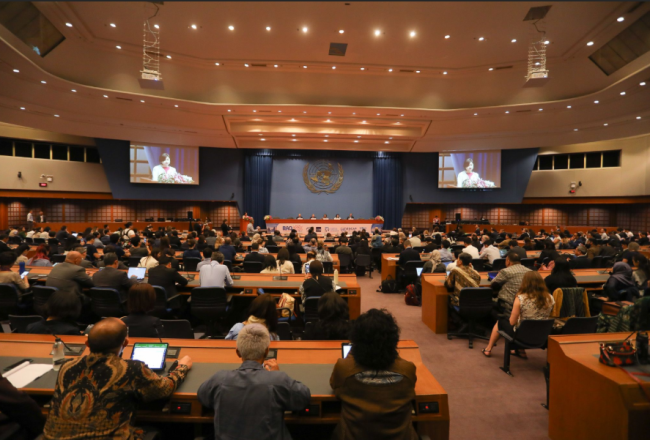
In March, we joined representatives from governments, non-governmental organizations, research institutions, and development institutions at the Better Air Quality Conference 2026 in Bangkok to highlight the urgent need to accelerate action on air pollution across Asia and the Pacific. From our vantage point, several key themes surfaced repeatedly, shaping a shared call to action for sustained, sector-specific strategies on reducing emissions embedded in sub-national and national action plans.
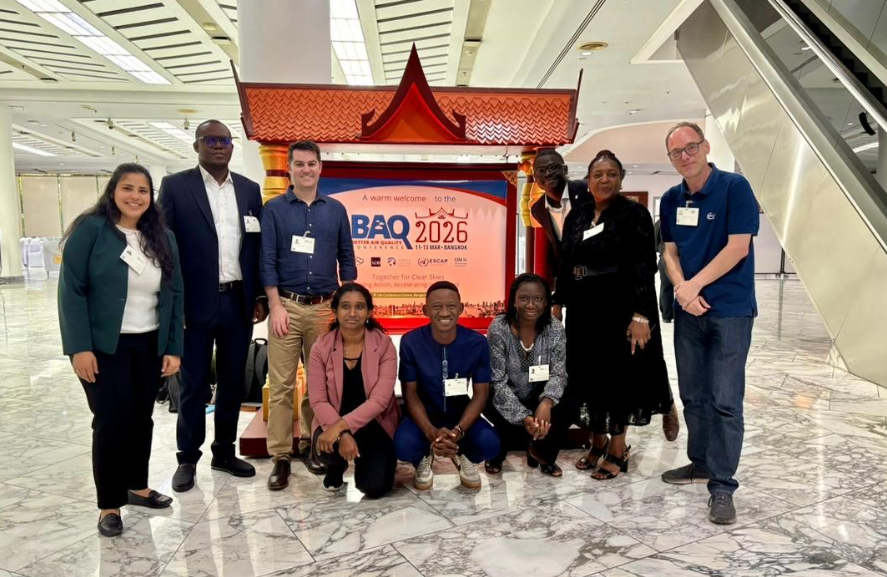
HEI staff with partners and collaborators at BAQ
Effective solutions for clean air already exist and are being implemented across the region, with opportunities for deployment at scale.
Attainable solutions include vehicle electrification, promotion of viable alternatives to crop residue burning supported by economic incentives for farmers, and expansion of access to clean cooking fuels and technologies. Impressive examples of scalable actions include:
- The People’s Republic of China has implemented clean air action in three phases from 2015 to 2025, progressing from the Air Pollution Prevention and Control Action Plan to the Blue-Sky Action Plan and the Action Plan for Sustained Air Quality Improvement.
- In Bangkok, between December 2025 and February 2026, high dust days were reduced by 40–50% compared to the previous season, and PM2.5 levels decreased by 22% in January 2026 compared to January 2025. Pornphrom N.S. Vikitsreth, Advisor to the Governor and Chief Sustainability Officer of Bangkok Metropolitan Administration noted that this was achieved by targeting key sources including diesel emissions and agricultural burning while also creating low-emission zones.
- The Clean Dhaka project resulted in an improvement in the city's waste collection rate from 40% in 2005 to around 80% in 2021. This was achieved through door-to-door collection system, improved transport and disposal infrastructure, and strengthening of institutional capacity.
While knowledge sharing platforms and regional initiatives are supporting exchange across cities and countries, the key challenge now lies in scaling the solutions through stronger governance, coordinated policy frameworks, sustainable financing, and multidisciplinary collaboration.
The evidence is clear: solutions and strategies should prioritize control of emissions at the source. Also, interventions should move beyond PM2.5 alone, with a stronger emphasis on a multi-pollutant approach that targets overall emission reductions. For example, PM₂.₅ levels have steadily declined in Japan and South Korea, but both countries have now seen a shift from increasing to decreasing trend for ozone levels as a result of decline in emissions of oxides of nitrogen (NOx) and volatile organic compounds (VOC) emissions declined. Key sources of NOx and VOCs include transport, industry, power generation, and solvent use.
Strengthening city-level action is essential, as cities are key drivers of change. However, isolated national initiatives alone are insufficient.
Cities including Delhi, Dhaka, Bangkok, and Jakarta have been a key focus of policy action. However, there is growing recognition that effective air‑quality management must extend beyond city boundaries to include surrounding regions and airsheds. For example, the Bangkok Metropolitan Administration (BMA) is developing a joint Pollution Control Zone plan with ten neighboring provinces across the region.
Advances in monitoring and forecasting are enabling more targeted interventions, such as making forecasting and real-time data publicly available through apps like Air4Thai and AirBKK in Thailand and supporting proactive measures like the Graded Response Action Plans in India, alongside the growing use of low-cost sensors and modelling approaches in the region. However, several countries, particularly in South and Central Asia, still lack robust monitoring networks, and strong regional data systems and emissions inventories that can be transformational for effective policy action.
The need for regional collaboration and South-South exchange could not be stronger.
The ASEAN Agreement on Transboundary Haze Pollution, adopted in 2002 by 10 countries, has provided a roadmap for regional cooperation to address transboundary air pollution. While significant progress has been made in some countries, air pollution continues to worsen in others. In South Asia, there are opportunities within existing mechanisms such as the 1998 Malé Declaration, to establish financing mechanisms for clean technology adoption, develop joint action plans, create regional emissions inventories and data-sharing platforms, and strengthen technical and institutional capacities. However, there is a critical need to revive it with strong political commitment from countries alongside support from multilateral development banks and philanthropic organizations to promote coordinated regional action. There is increasing recognition of the need to control air pollution within an airshed.
Moving from dialogue to delivery requires more than engagement. The most critical factor for action is political will. In recent years, countries have strengthened commitments through declarations such as the ASEAN Agreement on Transboundary Haze Pollution, Thimphu Outcome, and the Cape Town G20 Declaration. Governments across the region must come together to address a crisis that is already affecting the health of millions as their economies grow.
Building and strengthening institutions is key to unlocking finance and translating it into action.
As scientific understanding and data access expand, air pollution is increasingly recognized as a critical economic and development priority. To respond effectively, institutions, including environmental agencies and public health agencies, urban local bodies, air-shed authorities, and monitoring/regulatory agencies, need to be strengthened at the regional, national, and subnational levels so they can act on this growing evidence base. A 2025 study showed that enforcing policies that already exist could deliver significant improvements to air quality.
The Asian Development Bank and the Japan International Cooperation Agency (JICA) provide two-thirds of global outdoor air quality funding in Asia, some of which has gone towards strengthening the air quality infrastructure while the rest has shaped sectoral interventions from 2018-2022. For example, JICA has collaborated with the Thailand Pollution Control Department to develop emission inventories and models for simulating air quality. Additionally, The World Bank has recognized air pollution as a standalone investment priority with large economic and health returns, made a strong case for significant investment into clean air action across the Indo-Gangetic Plains and Himalayan Foothills and is currently working with governments in Pakistan and Bangladesh as well as the states of Uttar Pradesh and Haryana in India.
Expanding investment in clean air solutions will require stronger project preparation, including identifying low-hanging sectors with maximum benefits, mobilizing local funding sources within existing government project pipelines, and increasing engagement with the private sector. There were also discussions on market-based mechanisms; however, more work is needed to map pathways for implementation at scale and better linkage with climate policies.
For the people and driven by the people.
Meaningful engagement begins with communication. Those most affected by air pollution, including children, mothers, and related groups, such as teachers and doctors, can play a crucial role in fostering awareness. People can be empowered through community monitoring, greater transparency around air quality data, and collective clean-air campaigns. For example, the Thailand Clean Air Network (Thai CAN), has navigated the legal and political system to draft Thailand’s first citizen-led Clean Air Bill through advocacy efforts using webinars, social media campaigns, events, and exhibitions. UrbanBetter is bringing clean air conversations to streets and neighbourhoods through its work on Cityzens Hubs.
Optimism for clean air can feel challenging when work is done in isolation. Gathering with colleagues from around the world at BAQ reminded us that the air pollution crisis is not only solvable, but within reach when collaboration is prioritized. We look forward to connecting again at the next BAQ. In the meantime, we are eager to work with colleagues old and new to progress towards clean air for all.